


The advantage of optocouplers is that they can eliminate impedance mismatch and achieve high isolation voltage and excellent noise resistance in smaller package sizes. In addition, optocouplers can also be used to transmit DC and AC signals, analog and digital signals, as well as mid to low frequency signals.
The main tasks of optocouplers in circuits are to isolate users from hazardous electrical systems, isolate low-voltage control circuits from high-voltage circuits, and provide overvoltage protection for circuit systems.
Power adapters, household appliances, and smartphone chargers - these are all applications that require electrical isolation between two circuits. Electrical isolation can be achieved through the use of different methods such as transformers, capacitors, and optocouplers.
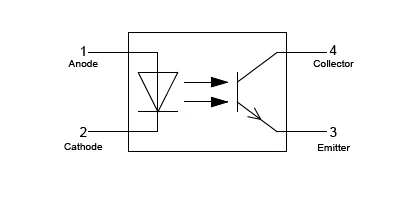
The structure of the optocoupler:
The simplest optocoupler is formed by coupling infrared LEDs with phototransistors, as coupling is achieved by light, electrical isolation can be achieved between the two. When the LED emits light, the phototransistor generates a current, and the current intensity is proportional to the light intensity.
There are two types of optocouplers on the market: DC input optocouplers and AC input optocouplers. The DC input optocoupler only has one LED on the input side, so it can only input unidirectional current. This type of optocoupler is commonly used in switch applications.
The AC optocoupler has two reverse parallel LEDs, allowing the input current to flow in both directions, resulting in an output of one and a half waves for each half cycle of the AC input signal.
How to extend lifespan? What parameters will affect the lifespan of optocouplers?
One of the main considerations in circuit design is the expected lifespan, which depends on the lifespan of the product itself and the individual components contained within it. When considering components, some components may completely fail or experience performance degradation over time. For optocouplers, the CTR performance will decrease over time, depending on the operating conditions.
The lifespan of optocouplers may exceed several decades, therefore more stringent conditions are needed to accelerate pressure testing.
For reliability testing, shortening the time of stress testing and predicting the final lifespan under normal usage conditions is very meaningful. When testing optocouplers at higher temperatures and currents, the aging process of the device is much faster than under normal operating conditions.
The aging rate of CTR depends on the forward current IF during operation and the ambient temperature TA during operation. It should be noted that CTR aging can be slowed down by lowering the operating temperature of the LED and lowering the driving forward current.
It is recommended to use the following methods to extend the service life of the optocoupler:
1. Reduce the effective working time of the optocoupler
2. Reduce the working current and power consumption of LED diodes
3. Avoid LED experiencing peak transient current
4. Adjust the duty cycle of the LED to maintain a lower average current