


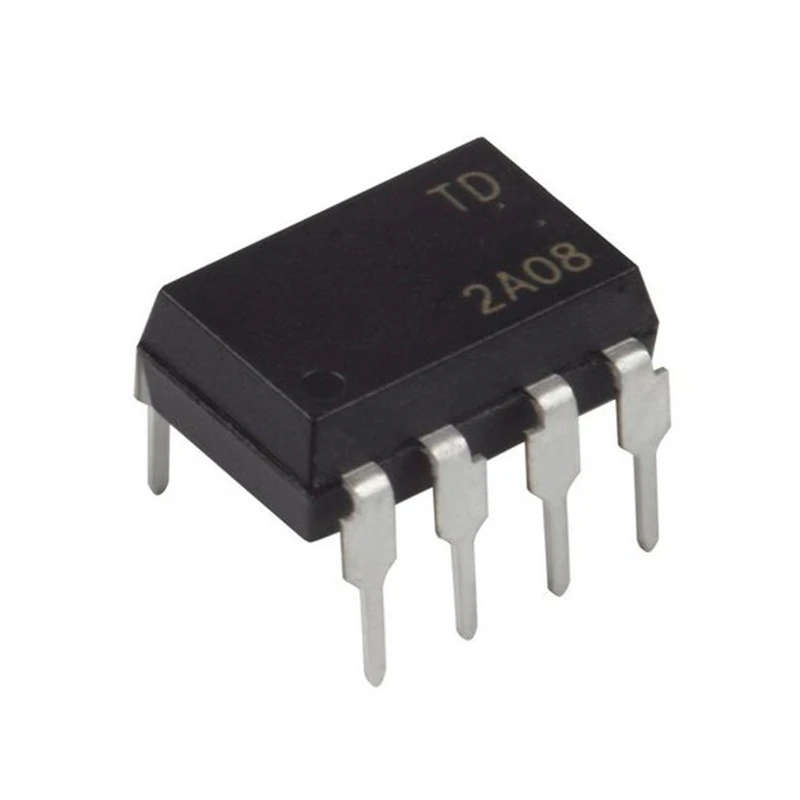
TD827 DIP8 DC Input Phototransistor Optocoupler Belong to DIP 8 AC Optocoupler
The TD827 series provide two channel operation, and each combines an AlGaAs infrared emitting diode as the...

AC Optocoupler
What is AC Optocoupler
Optocouplers and AC optocoupler are both used to pass a signal from one side of a system to another side when there is galvanic isolation. The isolation barrier normally prevents current from flowing between two sides of the component. The idea is to use an input signal to then trigger current flow on the output side.
Benefits of AC Optocoupler
Prevent ground loops in equipment that drives a remote load
Most ac-operated switching supplies (e.g., those used in computers, telecommunications, and instrumentation) use AC optocoupler for the isolated feedback path.
Suppress electrical noise effects
For example, it is difficult to take full advantage of a 16-bit ADC because the digital output signals (and noise on the digital ground to which you connect the converter’s output) get back into the analog front end. You can extricate yourself from noise with optical isolation of the digital half.
To get a signal up to a circuit floating at high voltage
Designers of high-voltage power supplies sometimes use AC optocoupler to get a signal up to a circuit floating at high voltage.
-
![DIP 8 AC Optocoupler]()
-
![SOP4 AC Optocoupler]() SOP4 AC OptocouplerTD354 AC input Optocoupler Belong to SOP4 AC Optocouplerread more
SOP4 AC OptocouplerTD354 AC input Optocoupler Belong to SOP4 AC Optocouplerread more
The TD354 series combine two AlGaAs infrared emitting diode as the AC input which is optically coupled to a silicon planar... -
![S SOP 4 AC Optocoupler]() S SOP 4 AC OptocouplerTD214 belong to SSOP4 DarliangtonTransistor Optocouplerread more
S SOP 4 AC OptocouplerTD214 belong to SSOP4 DarliangtonTransistor Optocouplerread more
The TD214 series combine two AlGaAs infrared emitting diodes as the emitter which is optically coupled to a silicon planar...


Why Choose us
Quality services
Our team is committed to delivering high-quality services to our clients. We use the latest technologies and tools to ensure that our services exceed your expectations.
01
Quality
We offer high quality services and products that are relatable and resonate with your business needs.
02
Experience and expertise
Our company has been in business for many years and has amassed significant expertise and experience to provide quality services to our clients.
03
Competitive pricing
We offer competitive pricing for our services without compromising on quality.
04
Certifications and quality standards
Choose a factory that adheres to industry standards and certifications to ensure product safety and quality.
05
Applications of AC Optocoupler
AC optocoupler for switching DC circuit
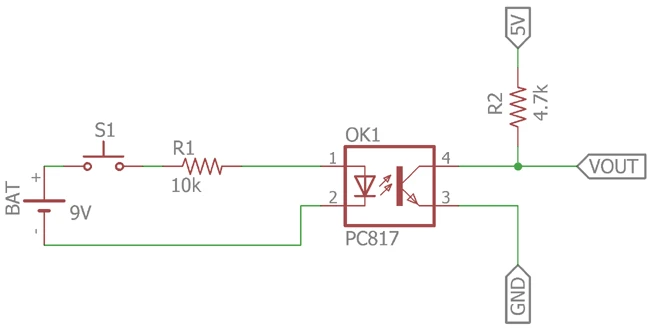
In the upper circuit a Photo-Transistor based optocoupler circuit is used. It will act like a typical Transistor switch. In the schematic a low cost photo-transistor based opto-coupler PC817 is used. The infra-red led will be controlled by the S1 switch. When the switch will be on, the 9V battery source will provide current to the LED via the current limiting resistor 10k.The intensity is controlled by the R1 resistor. If we change the value and make the resistance lower, the intensity of the led will be high making the transistor gain high.
On the other side the transistor is a photo-transistor controlled by the internal infra-red led, when the led emit infra-red light the photo transistor will contact and the VOUT will be 0 turning off the load connected across it. It is needed to remember that as per the datasheet the collector current of the transistor is 50mA. The R2 provide the VOUT 5v. The R2 is a pull-up resistor.
Optocoupler for detecting AC voltage
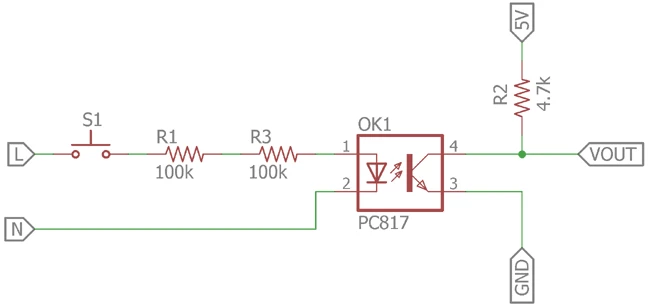
Here another circuit is shown to detect the AC voltage. The infra-red led is controlled using two 100k resistor. The two 100k resistor used instead of one 200k resistor is for extra safety for short-circuit related condition. The LED is connected across wall outlet Line (L) & Neutral line (N). When the S1 is pressed the led start to emit infra-red light. The photo transistor makes a response and converts the VOUT from 5V to 0V.
In this configuration the opto-coupler can be connected across low voltage circuit such as microcontroller unit where the AC voltage detection is required. The output will produce square High to Low pulse.
As of now the first circuit is used to control or switching the DC circuit and second is to detect the AC circuit and control or switch DC circuit. Next we will see controlling AC circuit using DC circuit.
Optocoupler for controlling AC Circuit using DC voltage
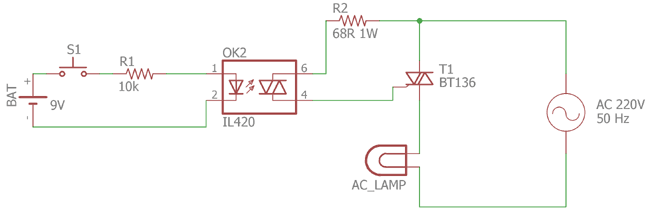
In the upper circuit The LED is again controlled by 9V battery through 10k resistor and the state of the switch. On the other side a photo-TRIAC based opto-coupler is used, which control the AC optocoupler from the 220V AC outlet. The 68R resistor is used to Control the BT136 TRIAC which is controlled by the photo-TRIAC inside the opto-coupler unit.
This type of configuration is used to control electrical appliances using low voltage circuitry. The IL420 is used in the upper schematic which is a photo-TRIAC based Opto-coupler.
Other than this type of circuitry an opto-coupler can be used in SMPS to sending secondary side short-circuit or over current condition information to the primary side.
Types of AC Optocoupler
Photo-transistor optocoupler
The Transistor type can be anything whether PNP or NPN.Photo-Transistor can be further of two types depending on the output pin availability.This pin 6 is used to control the sensitivity of the photo-transistor. Often the pin is used to connect with ground or negative using a high value resistor. In this configuration, false triggering due to noise or electrical transients can be controlled effectively.
Also, before using Photo-transistor based AC optocoupler, the user must know the maximum rating of the transistor. PC816, PC817, LTV817, K847PH are few widely used photo-transistor based optocoupler. Photo – Transistor based opto-coupler is used in DC circuit related isolation.
Photo-darlington transistor optocoupler
Darlington Transistor is two transistor pair, where one transistor controls other transistor base. In this configuration the Darlington Transistor provide high gain ability. As usual the LED emits infrared led and controls the base of the pair transistor.
This type of opto-coupler also used in DC circuit related area for the isolation. The 6th pin which is internally connected to the base of the transistor, used to control the sensitivity of the transistor as discussed previously in photo-transistor description. 4N32, 4N33, H21B1, H21B2, H21B3 are few photo-Darlington based opto-coupler example.
AC optocoupler
AC optocoupler is mainly used where AC based control or switching is needed. The led can be controlled using DC, and the AC optocoupler used to control AC. Opto-coupler provide excellent isolation in this case too. Here is one Triac Application. The AC optocoupler examples areIL420, 4N35 etc are example of TRIAC based opto-coupler.
Photo-SCR based optocoupler
SCR stand for Silicon controlled rectifier, SCR also referred as Thyristor. Same as like other opto-coupler the LED emit Infrared. The SCR is controlled by the intensity of the LED. Photo-SCR based Opto-coupler used in AC related circuitry. Learn more about Thyristor here.
Few Examples of photo-SCR based opto-couplers are:- MOC3071, IL400, MOC3072 etc.
Important AC Optocoupler Specifications
LED forward voltage and trigger current
This tells you how you need to power your input LED to ensure it turns on and provides the desired switching behavior. In AC optocoupler designed to be switched with a square wave or PWM signal, the peak forward current required to trigger the switch depends on the pulse width of the signal in the ON state. Shorter pulses require larger peak signal current to force triggering.
Output-to-input current ratio
This tells you the current transfer between each end of the AC Optocoupler. Note that this is dependent on the absolute maximum collector-emitter voltage for a phototransistor optocoupler.
Forward voltage vs. forward current curve
This specification has the same meaning as that for a standard LED, but it should not be confused with the trigger current.
Temperature variations
These specifications are quite important for power systems as they can reach high temperature during operation.
Safety ratings and IEC/UL certification
If you’re designing for a power system or for data transfer in a high voltage environment near AC mains, IEC 60747-5-2 is one important standard to watch for to ensure high transient voltages can be withstood. You need to follow the safety and insulation guidelines to ensure you’re compliant with safety standards.
Data rate or switch speed
Components that are intended for use in data networks will normally specify a maximum data rate, although a switching speed or frequency could also be specified.
What is the difference between an AC Optocoupler VS. Optoisolator?
How they operate
Both AC optocouplers and optoisolators allow the transfer of signals and data from one system to another within a piece of electronic equipment without a direct electrical connection. This is done optically by using a beam of light to an optical receiver in a single package with a light-conducting medium between the emitter and detector. This allows the total electrical isolation of electronic circuits while transmitting information from one voltage potential to another. In all optocouplers and optoisolators, input signals are converted to a pulse of light from an LED. This pulse of light is transmitted to a silicon photosensor.
Design considerations
The photosensor can be either analog or digital depending on the type of input signal to be transferred across the device. When an application requires an analog signal, such as for 4 to 20 mA, the photosensor can be either a photodiode or phototransistor. Both of these devices provide an analog output signal that can be used for a variety of analog applications.
An analog response is required for those applications where the amount of signal is critical to the operation of the system. The amount of current on the output of the device referenced to the amount of light into the LED is called the current transfer ratio (CTR), the output current divided by the input current. CTR values may vary from 10% to over 5,000%, depending on the gain of the system. Typically the lower the CTR, the faster the rise and fall times.
Analog devices normally require additional circuitry to be utilized by other components of the system. Digital output devices are best suited when the application requires a pulse, or bit output.
These devices are most often easier to use while providing a reliable signal that can interface directly with other system components. As long as sufficient light is shining on the photosensor, the output signal will be either high or low depending on the logic configuration.
A consideration facing designers is the speed of transmitting the digital data while minimizing the propagation delay. Most optoisolators/optocouplers are used for data rates below 10 Mbits/s, and the propagation delay may be in the 2 to 20-µs range.
The optocoupler
Optocouplers are specifically designed as small package devices similar to a Dual In-Line Package (DIP) or a surface-mount device (SMD), so that they take up the least amount of space while using light to transmit the data. The designer should pay attention to the definition of the isolation voltage potential because it may be identified as an ac, rms, or dc value.
The optoisolator
Optoisolators are available in a multitude of package styles including rectangles, cylinders, and specialty configurations. These package types are designed to provide higher isolation voltages than what can be achieved with DIP and SMD packages.
While using the optoisolator, the designer may need to take into consideration the environmental conditions. For example, percentage of humidity in the environment would be a key consideration if the system requires 50,000 V of dc isolation.
If the humidity in the air is too high, an arc may occur around the optoisolator or along the surface of the PCB, resulting in a conductive path and shorting around the device. Distance, temperature, barometric pressure, type, and amount of contaminate in the air, as well as humidity, define the breakdown potential exterior to the optoisolator.
Features of AC Optocoupler
Small size
This feature enables AC Optocoupler circuits to adapt to more integrated circuits. For example, our 817 optocouplers are tiny, with their size reaching 6.4×4.6×3.50, making them widely used for various applications.
Quick response
The response of optocouplers can achieve in milliseconds or even microseconds at the maximum level. Our optocoupler circuits can achieve such fast speed, improving working efficiency.
High resistance to shock
The isolation voltage refers to the maximum voltage that can be applied across the optocoupler circuit while ensuring electrical isolation. The higher it is, the better resistance to shock it brings. Generally, the isolation voltage exceeds 1kV, but our 817 optocouplers can even reach 5kv, showing high resistance to shock.
Good anti-interference ability
This can be achieved with good insulation ability existing between output and input. Our AC optocouplers can ensure high resistance to shock and anti-interfere ability.
Our Factory
Founded in 2004, Lighting Ltd. specializes in the packaging of medium- and high-power LED devices for lighting; and moved its factory to Fujian Hutou Optoelectronic Industrial Park in 2017.
In Fujian, we have more than 25,000 square meters of factory buildings and more than 20,000 square meters of ultra-clean, anti-static modern dust-free workshop.
Passed IATF16949, ISO9001, ISO14001, ISO45001 (OHSAS18001) quality management system certification.
Semiconductor packaging business since 2015; own optocoupler brand in 2018; optical sensor product line in 2020; integrated class packaging product line in 2021.
Dozens of invention and utility model patents, many authorized patents.
Responding to the strategic goal of China Chip: cooperating with domestic mainstream brands to actively create integrated products made in China.

Our Certificate
Product Certifications: ROHS, Reach, VDE, CQC, UL, IATF16949, ISO9001, ISO14001, ISO45001.

Asked Questions
As one of the leading ac optocoupler suppliers in China, we warmly welcome you to buy discount ac optocoupler from our factory. All customized products are with high quality and competitive price. For quotation and free sample, contact us now.
for LTV 354, for EL3H4, S SOP 4 AC Optocoupler