


TRIAC Optocoupler
What is a TRIAC optocoupler
A TRIAC optocoupler is composed of a light-emitting diode and a thyristor. It has the advantages of small size, high efficiency and long life. Can be used with discrete power triacs to interface logic systems with AC line powered equipment and are widely used in solid state relays, industrial controls, motors, solenoid valves and consumer equipment.
Advantages of TRIAC optocouplers
TRIAC optocoupler has the following characteristics:
Small size, light weight, long life and high reliability
The use of MOSFET structure greatly reduces the size of the product, and its weight is only 1/3 of an ordinary triac with the same power.
It can be easily integrated on single-chip microcomputer and microcomputer, and can be easily made into a patch type.
It has good high-frequency characteristics and uses the high input impedance and high drive capability of MOSFet to achieve fast turn-on at high frequencies.
Easy to design, easy to use and easy to maintain.
-
![SOP4 RP TRIAC]() SOP4 RP TRIACThe TDM301X and TDM302X and TDM305X and TDM307X series combine an AlGaAs infrared emitting diode as the emitter which is optically coupled to a monolithic silicon random-phase photo triac in a...read more
SOP4 RP TRIACThe TDM301X and TDM302X and TDM305X and TDM307X series combine an AlGaAs infrared emitting diode as the emitter which is optically coupled to a monolithic silicon random-phase photo triac in a...read more -
![DIP 6 Zero-Cross Optocoupler]() DIP 6 Zero-Cross OptocouplerTD3061 DIP6, DC Input, Zero-Cross Photo TRIAC Belong to DIP6 Zero-Cross Optocoupleread more
DIP 6 Zero-Cross OptocouplerTD3061 DIP6, DC Input, Zero-Cross Photo TRIAC Belong to DIP6 Zero-Cross Optocoupleread more
The TD303X, TD304X and TD306X seriescombine an AlGaAs infrared emitting diode as theemitter which is... -
![DIP 4 Zero-Cross Optocoupler]() DIP 4 Zero-Cross OptocouplerTD3063 belongs to DIP4 Zero Cross Optocoupler Photography Triac optical couplerread more
DIP 4 Zero-Cross OptocouplerTD3063 belongs to DIP4 Zero Cross Optocoupler Photography Triac optical couplerread more
The TD303X-4L, TD304X-4L and TD306X-4L series combine an AlGaAs infrared emitting diode as the emitter... -
![SOP 4 Random-Phase TRIAC]() SOP 4 Random-Phase TRIACThe TD301X and TD302X and TD305X and TD307X series combine an AlGaAs infrared emitting diode as the emitter which is optically coupled to a monolithic silicon random-phase photo triac in a plastic...read more
SOP 4 Random-Phase TRIACThe TD301X and TD302X and TD305X and TD307X series combine an AlGaAs infrared emitting diode as the emitter which is optically coupled to a monolithic silicon random-phase photo triac in a plastic...read more


Why Choose Us
Quality services
Our team is committed to delivering high-quality services to our clients. We use the latest technologies and tools to ensure that our services exceed your expectation
01
Quality
We offer high quality services and products that are relatable and resonate with your business needs.
02
Experience and expertise
Our company has been in business for many years and has amassed significant expertise and experience to provide quality services to our clients.
03
Competitive pricing
We offer competitive pricing for our services without compromising on quality.
04
Certifications and quality standards
Choose a factory that adheres to industry standards and certifications to ensure product safety and quality.
05
Application of silicon controlled optocoupler
 SCR optocouplers are widely used in various fields, mainly including the following aspects:
Industrial automation field: SCR optocouplers are suitable for high-precision and high-stability power control requirements, such as precise motor control in robot control systems to improve the stability and efficiency of production lines.
Power system field: By using thyristor optocouplers, fast and accurate power switching and control can be achieved, system equipment can be protected, and the safety and reliability of power transmission can be improved.
Field of home intelligence: SCR optocouplers also have broad application prospects in the field of home intelligence, such as lighting control systems, which can achieve precise adjustment and control of home lights and improve the comfort and energy-saving effect of the home environment.
Electronic circuit field: SCR optocouplers are widely used in various control circuits and switching circuits, such as time relays, switching power supplies, inverters, DC power supplies, frequency converters, etc.
Automation control field: As a commonly used photoelectric isolation device, thyristor optocoupler is used for signal isolation, safety isolation and other aspects in the automation control field, such as PLC, frequency converter, discrete controller, automatic control device, etc.
Instructions for using thyristor optocouplers
A thyristor optocoupler is an electronic component that combines a thyristor and an optocoupler. It is usually used for electrical isolation and control of high voltage and high current, especially in industrial control, motor drive, power conversion and other fields.
The usage instructions generally include the following aspects:
Choose the appropriate model: Choose a thyristor optocoupler with sufficient isolation voltage and current capacity according to the application situation.
Determine circuit parameters: Calculate relevant circuit parameters, such as resistance, capacitance, voltage, etc., to ensure that the thyristor optocoupler can operate normally under expected conditions.
Wiring and installation: Connect the input end (usually LED or photosensitive transistor part) and output end (thyristor part) of the thyristor optocoupler correctly, and pay attention to the requirements of electrical isolation. Ensure sufficient heat dissipation measures during installation.
Trigger control: Provide appropriate trigger signals for the thyristor optocoupler to conduct or turn off. This can be achieved by adjusting the current on the input side or changing the control signal of the optocoupler.
Monitoring and protection: Monitor the working status of the thyristor optocoupler and provide necessary protective measures, such as overheating protection, overcurrent protection, etc.
Attention: Relevant safety regulations must be followed during use to avoid electric shock and electrical accidents.
Types of controllable silicon optocouplers
Single channel thyristor optocoupler: This type of optocoupler has only one thyristor output channel and is usually used to control single-phase AC loads.
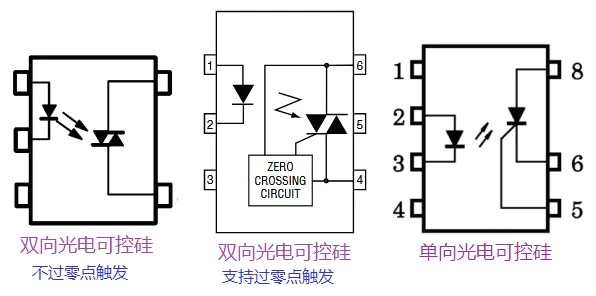
Dual channel thyristor optocoupler: This type of optocoupler has two independent thyristor output channels, which can control two different AC loads or a bidirectional thyristor.
Zero crossing trigger thyristor optocoupler: This type of optocoupler triggers thyristor conduction when the input signal reaches a certain threshold, and automatically turns off when the AC load voltage crosses zero, in order to reduce electromagnetic interference and improve efficiency.
Hysteresis triggered thyristor optocoupler: This type of optocoupler only triggers thyristor conduction when the input signal exceeds a hysteresis range, and only turns off when the input signal drops below a certain threshold, suitable for applications with fast response requirements.
High frequency thyristor optocoupler: This type of optocoupler has a high switching frequency and is suitable for high-frequency circuits that require fast switching.
High current thyristor optocoupler: This type of optocoupler can withstand large currents and is suitable for controlling high-power electrical equipment
Main parameters of silicon controlled optocoupler
Input current (IF): The operating current of the photosensitive element, usually specified in the specification sheet.
 Isolation voltage (Viso): The isolation voltage between the LED and the phototransistor.
Output current (IC): The maximum conduction current of the thyristor, also called the load current.
Working voltage (VDRM/VRRM): the maximum working voltage of the thyristor.
Response time: After the light signal arrives, the time delay for the thyristor to turn on or off.
Operating temperature range: The temperature range in which the device can operate normally.
In addition to the above parameters, it is also necessary to consider factors such as the device's voltage resistance, high temperature resistance, response speed, etc., and select the appropriate thyristor optocoupler model according to the needs of the specific application.
Our Factory
Founded in 2004, Lighting Ltd. specializes in the packaging of medium- and high-power LED devices for lighting; and moved its factory to Fujian Hutou Optoelectronic Industrial Park in 2017.
In Fujian, we have more than 25,000 square meters of factory buildings and more than 20,000 square meters of ultra-clean, anti-static modern dust-free workshop.
Passed IATF16949, ISO9001, ISO14001, ISO45001 (OHSAS18001) quality management system certification.
Semiconductor packaging business since 2015; own optocoupler brand in 2018; optical sensor product line in 2020; integrated class packaging product line in 2021.
Dozens of invention and utility model patents, many authorized patents.
Responding to the strategic goal of China Chip: cooperating with domestic mainstream brands to actively create integrated products made in China.

Our Certificate
Product Certifications: ROHS, Reach, VDE, CQC, UL, IATF16949, ISO9001, ISO14001, ISO45001

FAQ
Q: Popularity of TRIAC optocouplers
Q: How to distinguish between unidirectional thyristor and bidirectional thyristor? What are the differences in their characteristics?
Q: What factors will affect the performance of thyristor optocouplers?
As one of the leading triac optocoupler suppliers in China, we warmly welcome you to buy discount triac optocoupler from our factory. All customized products are with high quality and competitive price. For quotation and free sample, contact us now.
for TLP3021, SOP 4 Random Phase TRIAC, for S11MD5V