


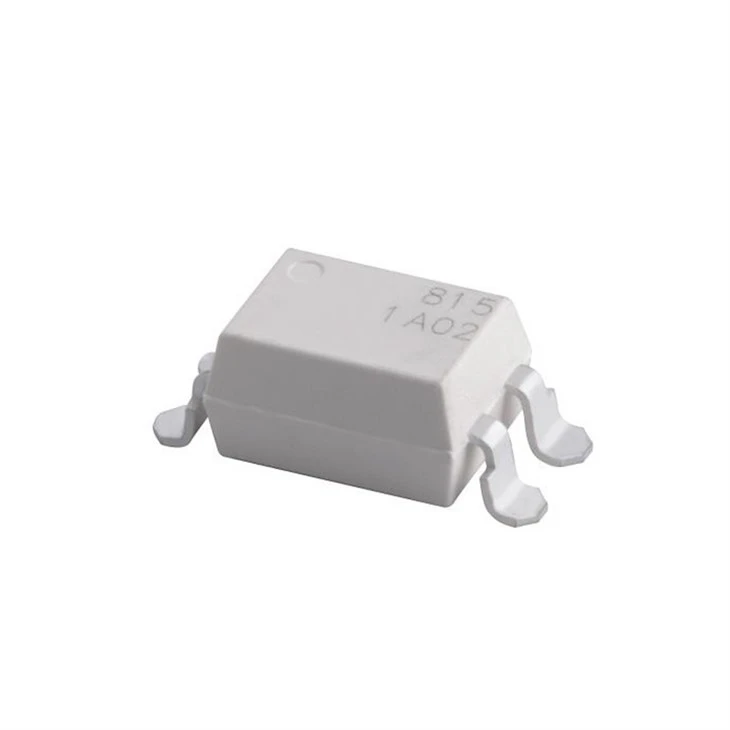

Product Parameter (Specification)
Features
High isolation 5000 VRMS
CTR flexibility available see orderinformation
DC input with transistor output
Operating temperature range - 55 °C to110 °C
REACH compliance
Halogen free
MSL class 1
Regulatory Approvals
UL - UL1577
VDE - EN60747-5-5(VDE0884-5)
CQC - GB4943.1, GB8898
|
ABSOLUTE MAXIMUM RATINGS |
||||
|
PARAMETER |
SYMBOL |
VALUE |
UNIT |
NOTE |
|
INPUT |
||||
|
Forward Current |
IF |
60 |
mA |
|
|
Peak Forward Current |
IFP |
1 |
A |
1 |
|
Reverse Voltage |
VR |
6 |
V |
|
|
Input Power Dissipation |
PI |
100 |
mW |
|
|
OUTPUT |
||||
|
Collector - Emitter Voltage |
VCEO |
40 |
V |
|
|
Emitter - Collector Volt |
VECO |
6 |
V |
|
|
Collector Current |
IC |
80 |
mA |
|
|
Output Power Dissipation |
PO |
150 |
mW |
|
|
COMMON |
||||
|
Total Power Dissipation |
Ptot |
200 |
mW |
|
|
Isolation Voltage |
Viso |
5000 |
Vrms |
2 |
|
Operating Temperature |
Topr |
-55~110 |
°C |
|
|
Storage Temperature |
Tstg |
-55~125 |
°C |
|
|
Soldering Temperature |
Tsol |
260 |
°C |
|
|
ELECTRICAL OPTICAL CHARACTERISTICS at Ta=25° |
|||||||
|
PARAMETER |
SYMBOL |
MIN |
TYP |
MAX |
UNIT |
TEST CONDITION |
NOTE |
|
INPUT |
|||||||
|
Forward Voltage |
VF |
- |
1.24 |
1.4 |
V |
IF=10mA |
|
|
Reverse Current |
IR |
- |
- |
10 |
μA |
VR=6V |
|
|
InputCapacitance |
Cin |
- |
10 |
- |
pF |
V=0,f=1kHz |
|
|
OUTPUT |
|||||||
|
Collector Dark Current |
ICEO |
- |
- |
100 |
nA |
VCE=10V,IF=0 |
|
|
Collector-Emitter Breakdown Voltage |
BVCEO |
40 |
- |
- |
V |
IC=0.1mA,IF=0 |
|
|
Emitter-Collector Breakdown Voltage |
BVECO |
6 |
- |
- |
V |
IE=0.1mA,IF=0 |
|
|
TRANSFER CHATACTERISTICS |
|||||||
|
Current Transfer Ratio |
CTR |
600 |
- |
7500 |
% |
IF=1mA,VCE=2V |
|
|
Collector-Emitter Saturation Voltage |
VCE(sat) |
- |
0.8 |
1.0 |
V |
IF=20mA,IC=5mA |
|
|
Isolation Resistance |
RISO |
10^12 |
10^14 |
- |
Ω |
DC500V,40~60%R.H. |
|
|
Floating Capacitance |
CIO |
- |
0.4 |
1 |
pF |
V=0,f=1MHz |
|
|
Response Time(Rise) |
tr |
- |
95 |
300 |
μs |
VCE=2V,IC=10mA RL=100Ω |
3 |
|
Response Time(Fall) |
tr |
- |
84 |
250 |
μs |
3 |
|
|
Cut-off Fraquency |
fc |
- |
1 |
- |
kHz |
VCE=2V,IC=10mA RL=100Ω,-3dB |
4 |
Product Feature And Application
High isolation voltage: typically up to several thousand volts, ensuring effective isolation between input and output circuits.
Fast response time: suitable for high-speed signal transmission.
Wide working temperature range: capable of stable operation within a wide temperature range.
High reliability: Due to its simple structure and non-contact signal transmission method, PC815 optocoupler has a long service life and high reliability
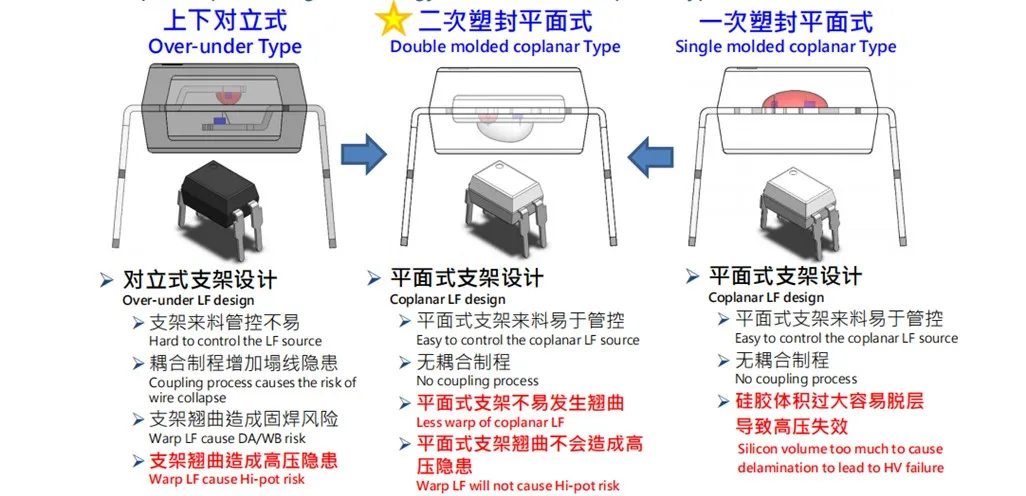

In terms of performance, it can replace Everlight EL815, Liteon LTV-815, Ctmicro CT815, Sharp PC815/81510, Cosmo KPC815, Fairchild H11B815, Renesas PS2502X-1/2562X-1,and Vishay K815P/SFH612A/655A.
The CTR is 600-7500%, widely used in switch mode power supplies, smart meters, industrial control, measuring instruments, office equipment (copiers), household appliances (air conditioning, fans, water heaters).
Prodection Details
DIP4 DarliangtonTransistor Optocoupler
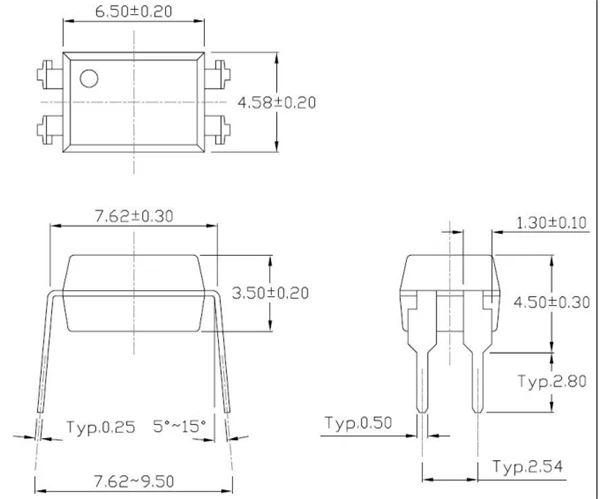
Package Dimensions (Dimensions in mm unless otherwise stated)
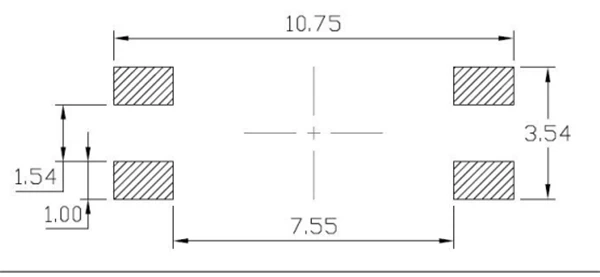
Recommended Solder Mask (Dimensions in mm unless otherwise stated)
Prodect Qualification


Deliver, Shipping And Serving

Latest News


FAQ
1.The structure of 815 optocoupler?
The 815 optocoupler consists of a light-emitting diode, a photosensitive transistor, a photodiode, and a phototransistor. Among them, light-emitting diodes are responsible for emitting light signals, photosensitive transistors are responsible for receiving light signals, and photodiodes and phototransistors are responsible for converting light signals into electrical signals.
2.The principle of 815 optocoupler?
The working principle of 815 optocoupler is based on the photoelectric effect. When the light-emitting diode is driven by current, it will emit a light signal. A photosensitive transistor will generate current under the illumination of light signals. Photodiodes and phototransistors are responsible for converting optical signals into electrical signals.
3.815 What is the role of optical coupling in communication systems?
815 Optical coupling has the following functions in the communication system: Electrical isolation: 815 optical coupling realizes complete electrical isolation of input and output terminals, prevent signal backflow and mutual interference in the communication system, and improve the quality and stability of signal transmission. Signal transmission: 815 optical coupling can realize the conversion of electrical signal to optical signal, and then the optical signal is converted into electrical signal. This conversion process can reduce the loss and interference in the signal transmission process, and improve the quality and speed of signal transmission. Photoelectric switch: 815 optocoupler can be used as a photoelectric switch, to control the circuit on and break of the communication system through the optical signal, to realize the control and monitoring of the operating state of the communication equipment. Photoelectric isolator: the 815 optocoupler can be used as a photoelectric isolator to prevent electromagnetic interference in the communication system and ensure the stability and reliability of signal transmission. Photoelectric coupler: 815 optocoupler can be used as a photoelectric coupler to realize the conversion between the optical signal and the electrical signal. In devices such as optical fiber sensors, optical detectors and optical receiver, 815 optical coupling can realize the reception of optical signals and the output of electrical signals. Signal amplification: In the communication system, 815 optical coupling can be used with the optical amplifier to realize the signal amplification in the process of signal transmission and improve the distance and coverage of signal transmission. Signal distribution: By using 815 optical coupling, the split transmission of signals in the communication system can be realized, and a signal can be divided into multiple signals to different devices. This can improve the flexibility and scalability of the communication equipment, while reducing the load of individual transmission links and improving the quality of signal transmission. In short, 815 optical coupling has a wide application prospect in communication systems, which provides a strong guarantee for the safe, stable and reliable operation of the equipment. In the practical application process, it is necessary to choose the appropriate 815 optical coupling models and parameters according to the specific scenarios and equipment requirements.
4.Design points of high-voltage linear optocoupler circuit?
1. Selection of photodiodes: When designing high-voltage linear optocoupler circuits, it is necessary to choose photodiodes suitable for high-voltage environments. Photodiodes with high sensitivity and fast response are usually chosen to ensure the accuracy and stability of transmission.
2. Driver circuit design: In order to ensure that the LED can work properly, a suitable driver circuit needs to be designed. This circuit typically includes a current limiter and a voltage regulator to ensure that the LED operates at the appropriate current and voltage.
3. Isolation circuit design: In order to achieve isolation between the input circuit and the output circuit, it is necessary to design a suitable isolation circuit. This circuit typically uses the reverse current of a photodiode as the input signal and converts it into an output voltage through appropriate circuit design. Common isolation circuits include optocoupler amplifiers and isolation transformers.
4. Noise suppression: Noise is a common issue in high-voltage linear optocoupler circuits. In order to reduce the impact of noise on signal transmission, a series of noise suppression measures can be taken, such as the application of filters, ground isolation, and signal amplification.
5. Safety considerations: Safety is an important consideration in the design of high-voltage linear optocoupler circuits. It is necessary to ensure that the circuit can operate stably and withstand the test of high voltage environment. In addition, appropriate protective measures should be taken to prevent high voltage in the circuit from causing harm to personnel and equipment
5.Application of 815 Optocoupler?
Signal transmission: TD815 optocoupler can convert electrical signals into optical signals, and then convert the optical signals back into electrical signals, achieving stable and reliable signal transmission, especially in situations that require long-distance transmission or anti-interference.
Circuit protection: TD815 optocoupler can be used for circuit protection, such as cutting off power through optocoupler in case of overload or short circuit, to prevent circuit damage.
Switching power supply: In switching power supplies, TD815 optocouplers are commonly used in feedback circuits to provide stable voltage or current feedback signals, ensuring stable output of the power supply.
Industrial control: In industrial control systems, TD815 optocouplers can be used for signal isolation and transmission, ensuring accurate transmission of control signals while providing electrical isolation protection.
Medical devices: TD815 optocouplers can be used in devices such as electrocardiograms, oximeters, and blood pressure monitors to convert electrical signals generated by the human body into optical signals for transmission, improving the performance and reliability of medical equipment.
In the field of communication: In fiber optic communication, fiber optic sensing, and fiber optic measurement, TD815 optocoupler can convert electrical signals into optical signals for transmission, achieving high-speed, stable, and long-distance communication.
Hot Tags: dip 4 darlingtontransistor, China dip 4 darlingtontransistor suppliers, SMD 0805 Jumper 31 6A, 3535 SMD IR LED 1050NM, 2835 IR LED 740 nm, Thin Film Zero Ohm Jumper Resistors, SOP 4 Darlington, SMD 5930 Matel Element 7W


