


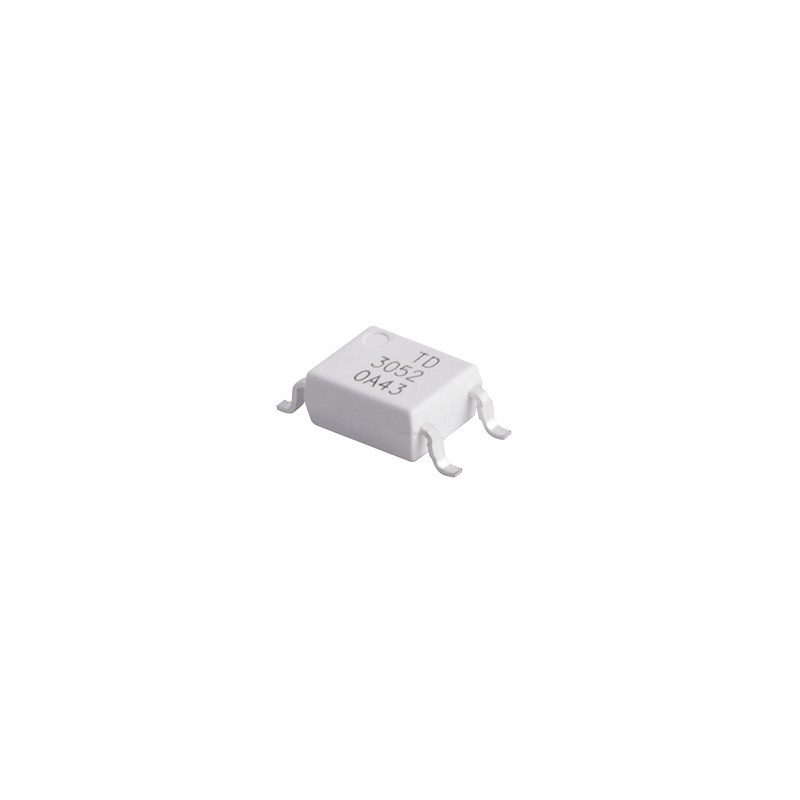
product parameter (specification)
Features
l High isolation 3750 VRMS
l DC input with random-phase photo triac output
l Operating temperature range - 40 °C to 100 °C
l REACH & RoHS compliance
l Halogen free
l MSL class 1
l Regulatory Approvals
n UL - UL1577
n VDE - EN60747-5-5(VDE0884-5)
n CQC - GB4943.1, GB8898
n cUL- CSA Component Acceptance
|
ABSOLUTE MAXIMUM RATINGS |
|||||
|
PARAMETER |
SYMBOL |
VALUE |
UNIT |
NOTE |
|
|
INPUT |
|||||
|
Forward Current |
IF |
60 |
mA |
||
|
Reverse Voltage |
VR |
6 |
V |
||
|
Junction Temperature |
Tj |
125 |
°C |
||
|
Input Power Dissipation |
PI |
100 |
mW |
||
|
OUTPUT |
|||||
|
Off-state Output Terminal Voltage |
TDM301X |
VDRM |
250 |
V |
|
|
TDM302X |
400 |
||||
|
TDM305X |
600 |
||||
|
TDM307X |
800 |
||||
|
Peak Repetitive Surge Current PW=100μs, 120pps |
ITSM |
1 |
A |
||
|
On-State RMS Current |
IT(RMS) |
100 |
mA |
||
|
Junction Temperature |
Tj |
125 |
°C |
||
|
Output Power Dissipation |
PO |
300 |
mW |
||
|
COMMON |
|||||
|
Total Power Dissipation |
Ptot |
330 |
mW |
||
|
Isolation Voltage |
Viso |
3750 |
Vrms |
1 |
|
|
Operating Temperature |
Topr |
-40~100 |
°C |
||
|
Storage Temperature |
Tstg |
-55~125 |
°C |
||
|
Soldering Temperature |
Tsol |
260 |
°C |
2 |
|
|
ELECTRICAL OPTICAL CHARACTERISTICS at Ta=25°C |
||||||||
|
PARAMETER |
SYMBOL |
MIN. |
TYP. |
MAX. |
UNIT |
TEST CONDITION |
NOTE |
|
|
INPUT |
||||||||
|
Forward Voltage |
VF |
- |
1.24 |
1.4 |
V |
IF= 10mA |
||
|
Reverse Current |
IR |
- |
- |
10 |
μA |
VR=6V |
||
|
Input Capacitance |
Cin |
- |
8.5 |
250 |
pF |
V=0, f=1kHz |
||
|
OUTPUT |
||||||||
|
Peak Off-state Current, Either Direction |
IDRM |
- |
- |
100 |
nA |
VDRM=Rated VDRM IF=0 |
3 |
|
|
Peak On-state Current, Either Direction |
VTM |
- |
1.58 |
2.5 |
V |
ITM= 100mA |
||
|
Critical Rate of Rise of Off-state Voltage |
dV/dt |
1000 |
- |
- |
V/ μs |
VPEAK =400V |
4 |
|
|
TRANSFER CHARACTERISTICS |
||||||||
|
LED Trigger Current |
TDM3010,TDM3021, TD3051,TD3071 |
IFT |
- |
- |
15 |
mA |
Terminal Voltage = 3V ITM= 100mA |
|
|
TDM3011,TDM3022, TDM3052,TDM3072 |
- |
- |
10 |
|||||
|
TDM3012,TDM3023, TDM3053,TDM3073 |
- |
- |
5 |
|||||
|
Holding Current |
IH |
- |
257 |
- |
μA |
|||
|
Isolation Resistance |
Riso |
10^12 |
10^14 |
- |
Ω |
DC500V, 40 ~ 60% R.H. |
||
|
Floating Capacitance |
CIO |
- |
0.4 |
1 |
pF |
V=0, f=1MHz |
||
product feature and application

3052 mainly consists of two key parts:
Light emitting diode (LED): responsible for converting input electrical signals into optical signals.
Phototransistor (TriaC): Responsible for converting received optical signals back into electrical signals and controlling the conduction and cutoff of AC circuits.
working process
Conversion of input signal to optical signal: When the input signal is applied to the LED pin of MOC3052, the LED will emit an optical signal
Optical signal transmission: This optical signal is transmitted to the phototransistor through an isolation layer (usually an optical isolation layer)
Conversion of optical signal into electrical signal: After the photosensitive transistor senses the optical signal, it converts it into current
Control AC circuit: When the photosensitive transistor receives sufficient light signal, it will conduct and transmit current to the control terminal of the TRIAC. TRIAC is a bidirectional thyristor switch that can control the conduction and cutoff of AC circuits. Specifically, when the phototransistor is turned on, the TRIAC will conduct, allowing AC power to pass through; When the phototransistor is turned off, the TRIAC will cut off, blocking the passage of alternating current.
Precise control of output voltage: By adjusting the intensity and frequency of the input signal, the conduction and cutoff timing of the phototransistor can be controlled, thereby achieving precise control of the output voltage
SOP4 RP TRIAC TDM3052 In terms of performance, it can replace Everlight ELM3052, Liteon LTV-3052, CTMICRO CTM3052, Toshiba TLPTLP160J/165J/260J/265J/267J, Sharp PC3SG11TIZ/S2S3AOOF/S2S5A0OF/PC3SH13YFZAH, COSMO KTLP160J/165J/260J, FAIRCHILD FODM3051/3052/3053, and can use bidirectional thyristor optocouplers to control the conduction of bidirectional thyristors, drive motors, light sources, and other loads, and achieve functions such as speed regulation and dimming.
In the field of control and drive, bidirectional thyristor optocouplers are widely used; Temperature control, motor control, incandescent lamp dimmer, AC power switch, electromagnetic valve control;

prodection details
SOP4 RP TRIAC
PACKAGE DIMENSIONS (Dimensions in mm unless otherwise stated)

Surface Mount Lead Forming & Surface Mount (Low Profile) Lead Forming

prodect qualification


Deliver,shippingandserving

Latest news


FAQ
Q: 1.The difference between transistor optocoupler and thyristor optocoupler
Transistor optocouplers typically consist of a light-emitting diode (LED) and a photosensitive transistor (phototransistor), used to convert light signals into electrical signals.
The thyristor optocoupler consists of an LED and a thyristor device (such as bidirectional thyristor or three terminal thyristor), used to achieve power control and switch control functions.
Functional differences
Transistor optocouplers are mainly used for signal isolation and transmission, which can convert input signals (current or voltage) into output signals, achieving electrical isolation function.
The thyristor optocoupler is suitable for power control and switch control, and can achieve control and adjustment of high-power equipment, with high power control ability.
Q: 2.Industry applications of controllable silicon optocouplers.
Power Electronics: In the field of power electronics, thyristor optocouplers are used in devices such as power switches, power control, electric vehicle charging stations, and battery management systems (BMS). It can achieve accurate control and protection of voltage and current, improving the safety and performance of equipment.
Medical equipment: Silicon controlled optocouplers are used in medical equipment to control and protect circuits, such as heart rate monitors, X-ray machines, medical laser equipment, etc. It can achieve isolation of equipment signals and power supply, ensuring stable operation and safe use of the equipment.
Automotive Electronics: In the field of automotive electronics, thyristor optocouplers are used for vehicle power management, drive control, charging station control, and other aspects. It can achieve charging and discharging control of electric vehicle batteries, control of driving motors, and improve the energy efficiency and safety of automobiles.
Communication equipment: Silicon controlled optocouplers are used in communication equipment for power management, signal isolation, and control, such as fiber optic communication equipment, network switches, routers, etc. It can achieve isolation and protection of signals and power sources, improving the stability and reliability of equipment.
Overall, thyristor optocouplers are widely used in industrial control, power electronics, medical equipment, automotive electronics, and communication equipment to achieve electrical isolation, signal transmission, and control functions, improve system reliability and safety.
Q: 3.The role of optocoupler in the high-speed hair dryer scheme
In the motor control circuit of the high-speed air duct, optocouplers are used to separate the control circuit from the motor high-voltage circuit. The motor relies on MOSFET or IGBT power transistors to provide driving current, and the switch control signal of the power transistor needs to be isolated and amplified from the high-power transistor. In the connection form of optocoupler isolation stage amplifier stage high-power transistor, it is required that the optocoupler has high output voltage, high speed, and high common mode suppression.
Hot Tags: sop4 rp triac, China sop4 rp triac suppliers, for PS9117A, AC Optocoupler, for TLP351A, SOP 4 High Voltage Transistor, Resistors, DIP 6 Zero Cross Optocoupler


